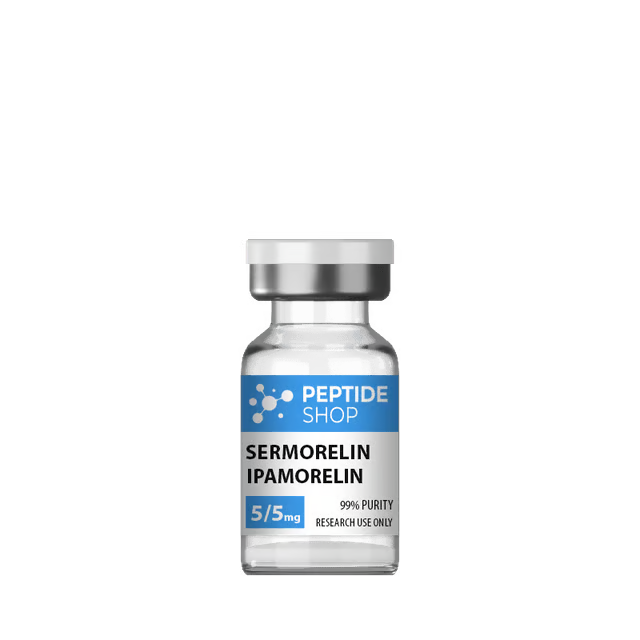
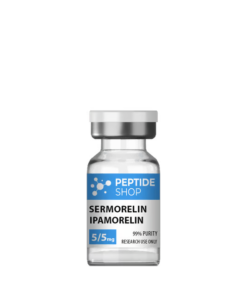
Sermorelin Ipamorelin
Original price was: $120.00.$100.00Current price is: $100.00.
Purified peptide solution 5mg/5mg
These two peptides are often combined due to their synergistic properties. Research and laboratory applications have allowed scientists to demonstrate that the mixture of sermorelin and ipamorelin can slow the aging process, decrease fat mass, increase muscle mass, promote gut health, and reduce inflammation.
These two peptides mimic the body’s natural hormones to stimulate the release of growth hormones by the pituitary gland.
Research on Sermorelin and Ipamorelin
Sermorelin
This peptide is an analog of GHRH (growth hormone-releasing hormone), which stimulates the pituitary gland to release endogenous growth hormone. By mimicking the first 29 amino acids of GHRH, serorelin would retain the biological activity necessary for the activation of GHRS (growth hormone secretagogue receptor).
Researchers believe this peptide could be particularly valuable for understanding how growth hormone influences anabolic processes such as metabolic regulation, cell growth, and protein synthesis. Furthermore, the potential impact of sermorelin on the modulation of IGF-1, a mediator of growth hormone activity, has garnered significant interest from the scientific community due to its implications for tissue regeneration and differentiation.
Ipamorelin
Ipamorelin is classified as a growth hormone (GHS) secretagogue. Some studies have confirmed its ability to bind to the growth hormone receptor (GHSR) in the hypothalamus and pituitary gland. Compared to other growth hormone secretagogues, ipamorelin is considered highly selective.
Scientists believe this peptide can trigger GH release without significantly altering other hormones such as prolactin or cortisol. Therefore, this selective action suggests that ipamorelin could be a promising tool for research on tissue growth and energy homeostasis.
The synergy of sermorelin and ipamorelin
Studies suggest that combining these two peptides could have a complementary effect, potentially stimulating GH release in a controlled manner. This has led scientists to believe that this peptide mixture could be useful in research areas where selective and balanced GH stimulation is desirable.
These two peptides could target GH release: ipamorelin via GHRS and sermorelin via GHRH. This synergy between these two peptides could open new research avenues, particularly regarding the regulation of cell longevity, tissue repair, and anabolic processes. Furthermore, it has been suggested that the mixture of sermorelin and ipamorelin could provide unique insights into the temporal profiles of growth hormone release, thus offering new avenues for studying metabolic cycles, endocrine signaling, and circadian rhythms.
Regenerative studies
One of the most promising areas of study for this mixture is regenerative medicine. Growth hormone is known for its impact on cell regeneration, particularly in connective and muscle tissues. It has been observed that the combined action of these peptides could help researchers study cell repair, recovery, and tissue regeneration in cases of tissue degradation or injury.
Based on research conducted on animals, scientists believe this mixture could be relevant for studying the repair mechanisms of cartilage, ligaments, tendons and skeletal muscles, where growth hormone plays an important role in promoting the proliferation of progenitor cells.
Endocrine and metabolic
Scientists believe that the combination of sermorelin and ipamorelin could influence metabolic processes. Given that growth hormone regulates fat metabolism, glucose homeostasis, and metabolism in general, this peptide combination could be used to study metabolic conditions such as energy expenditure, adipose tissue differentiation, and insulin resistance in the laboratory.
Summary
It has been hypothesized that this mixture offers a unique framework for studying the complex psychological roles of growth hormone and its broader implications in metabolic regulation, neuroendocrinology, and regenerative sciences.
By studying the distinctive mechanisms that stimulate GH release, sermorelin and ipamorelin could offer scientists a powerful tool to study growth hormone dynamics in a controlled laboratory environment.
Be the first to review “Sermorelin Ipamorelin”
Related products
Peptides
Peptides
Peptides
Peptides
Peptides
Peptides
Peptides
Peptides
Reviews
There are no reviews yet.